
Searching for earphones top rated by someone who used them longer than an afternoon? That is the right question. A polished launch video can tell you about drivers, codecs, and battery claims, but it cannot tell you whether an earbud stays comfortable after a two-hour flight or whether the case still charges reliably after a month in a pocket.
I spent weeks with current models from Apple, Sony, Bose, Google, Samsung, and Jabra, using the same routine for each. I listened to podcasts at low volume, streamed music on an Android phone and an iPhone, made calls beside a busy road, and wore each pair during walks and stationary-bike sessions. Spec sheets are free. Truth takes a few weeks.
How I tested the earphones top rated contenders
My first test was fit. I used the supplied ear tips, tried each size, and wore the earbuds for at least 90 minutes without adjusting them. A good seal matters because it improves bass and passive noise isolation. If the earphones became irritating before the playlist ended, the score dropped regardless of impressive sound quality.
For battery testing, I charged each case fully, set playback around a normal indoor listening level, and recorded the time until the earbuds shut down. I repeated the run rather than trusting the advertised maximum. Manufacturers often quote results with noise cancellation disabled, which is not how many people use premium earbuds. Noise cancellation, commonly called ANC, uses microphones and processing to reduce outside sound; it also consumes more power.
Call quality received its own test. I made calls from a quiet room, a windy sidewalk, and a kitchen while the exhaust fan ran. I listened for voice compression, dropouts, and how well each microphone rejected background noise. Finally, I checked controls, Bluetooth stability, app quality, and whether switching between devices worked without repeated repairs in the settings menu.
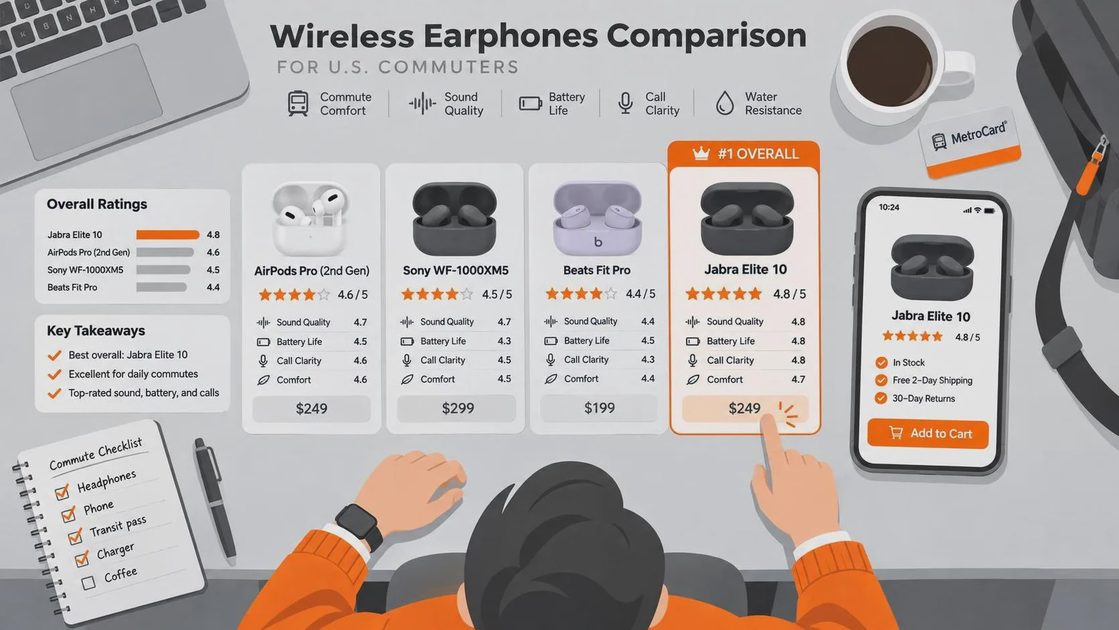
The earphones top rated for most iPhone owners
The Apple AirPods Pro 2 remain the easiest recommendation for people already using an iPhone. Their pressure-sensitive stems are simple to operate, the transparency mode sounds natural, and the case is compact enough to disappear in a jeans pocket. Conversation awareness can lower playback when you start talking, although I sometimes triggered it unintentionally while speaking to my kids.
Noise cancellation is strong for an in-ear design, especially with steady sounds such as airplane engines and air conditioners. Music has a clean, slightly warm presentation that works well across pop, acoustic tracks, and podcasts. The main limitation is ecosystem focus. They work with Android phones, but several useful features and the smoothest device switching are tied to Apple hardware. At roughly $249 before frequent discounts, they are not cheap, but the overall experience makes them among the earphones top rated for iPhone households.
The best Android-friendly choice for sound
The Sony WF-1000XM5 is my pick for listeners who want fuller sound and extensive control. Sony's app offers equalizer settings, adaptive noise cancellation, and a useful way to adjust how much outside sound enters. The earbuds can sound bass-heavy on their default setting, but a small equalizer adjustment gives guitars and vocals more space without making the presentation thin.
Fit is more personal than Sony's marketing suggests. The foam-like tips sealed well for me, but they can feel snug during long sessions. Call performance improved over earlier Sony models, though wind still challenged the microphones. Battery life was competitive in my repeated runs, with ANC active and several top-ups from the case. For an Android user who values sound customization over absolute simplicity, these are some of the earphones top rated in the premium category.
The Google Pixel Buds Pro 2 deserve consideration for Pixel owners who want a lighter, less intrusive design. Their small wings helped keep them steady during walks, and the transparency mode made conversations easy without removing an earbud. They do not deliver quite the same musical detail as the Sony pair, but their comfort and Google integration are strong practical advantages.
What about Bose, Samsung, and less expensive models?
The Bose QuietComfort Ultra Earbuds are the specialists for difficult noise. On a long flight, their cancellation handled low engine rumble better than most rivals I tested. The tradeoff is a larger charging case and a fit that some ears will find bulky. They make sense for frequent travelers, but I would not buy them solely for a feature such as spatial audio, which adds a theater-like effect that I found enjoyable only for selected recordings.
Samsung Galaxy Buds3 Pro fit naturally into a Galaxy phone setup and offer clear calls, strong integration, and a lively sound profile. Their value depends heavily on owning Samsung hardware. A user with a Motorola or iPhone will lose some of the reason to choose them.
For shoppers below $150, Anker Soundcore models often provide the most features per dollar. The Soundcore Liberty series commonly includes noise cancellation, an equalizer, and respectable battery life at prices far below Apple or Bose. Build quality and microphone consistency are not always as polished, so I would choose them for commuting or backup use rather than assume every budget model is one of the earphones top rated for all-day ownership.
How to choose earphones top rated for your routine
Start with your phone. iPhone users should prioritize reliable pairing, Find My support, and easy controls. Android users should compare the companion app and confirm that multipoint, meaning connection to two devices at once, works with their particular phone. Then decide whether your priority is travel, workouts, calls, or music. No pair wins every category.
For travel, spend more on effective noise cancellation and a comfortable seal. For workouts, look for an IP rating, which indicates resistance to water or dust; remember that sweat protection does not mean the earbuds are safe in a swimming pool. For office calls, microphone processing and transparency mode matter more than elaborate audio codecs. If you regularly misplace small electronics, a $90 pair can be a smarter purchase than a $280 flagship.
Also inspect the warranty and replacement-earbud policy. A lost earbud can turn a bargain into an expensive repair, while replaceable tips are inexpensive and often improve comfort more than a new audio feature. These practical details are why my list of earphones top rated does not simply copy the most popular launch-day products.
My final buying advice
The AirPods Pro 2 are the safest choice for iPhone owners, the Sony WF-1000XM5 is the more adjustable pick for serious Android listeners, and Bose remains compelling for travelers who want maximum noise reduction. Pixel and Samsung owners should look closely at their ecosystem options before crossing brands. Budget buyers should consider Anker Soundcore rather than chasing a suspiciously cheap flagship clone.
I would also wait for a sale. Premium earbuds regularly fall by $30 to $80 around major shopping periods, and last-generation models can become excellent values after a replacement arrives. Read return terms, test the fit on the first day, and listen in the places where you actually use them. The earphones top rated on a retailer page are not automatically the right pair for your ears, phone, or commute. I tested it. Here's what actually happened: comfort and dependable daily behavior beat one extra feature almost every time.
No letters yet — be the first to write.